
Past Event
Central American Slide Jam
About
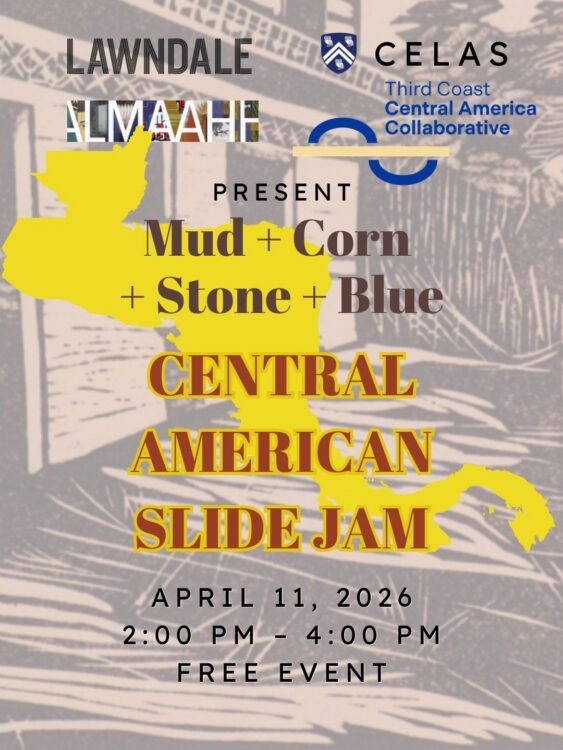
ALMAAHH, in collaboration with Lawndale, CeLAS, and The Third Coast Central America Collaborative (TCCAC), is pleased to announce a slide jam to highlight Central American artists to present their work in the Lawndale gallery in the framework of the show Mud + Corn + Stone + Blue curated by Laura August. Mud + Corn + Stone + Blue traces stories of the entangled lands of the United States and Central America. The traveling exhibition hinges on major conflicts that have scarred the region since the 1960s and how their histories are entwined with that of U.S. agriculture through the corn industry.
In celebration of this powerful exploration of Central American histories and artistic voices, ALMAAHH and Lawndale Art Center invite Houston-based Central American artists to participate in a Slide Jam Session —an informal platform where artists can present their work, practice, and thinking.
About ALMAAHH
Advocates of a Latino Museum of Cultural and Visual Arts & Archive Complex in Houston, Harris County (ALMAAHH) is a nonprofit organization dedicated to building an arts and culture hub that will cement Houston’s place as a leading city for American Latino cultural expression. Through partnerships and community-rooted programming, ALMAAHH works to ensure that American Latino histories and creative contributions are seen, celebrated, and sustained for generations to come.
About Mud + Corn + Stone + Blue
Told through a constellation of places and temporal back-and-forths, Mud + Corn + Stone + Blue traces stories of the entangled lands of the United States and Central America. The traveling exhibition hinges on major conflicts that have scarred the region since the 1960s and how their histories are entwined with that of U.S. agriculture through the corn industry. These conflicts include armed engagements in Guatemala (1960-1996), El Salvador (1980-1992), and Nicaragua (1979-1990); U.S. interventions in Honduras in the 1980s; and even the Tractorcade (1979) in the U.S. Corn Belt, when farmers drove more than 900 tractors to Washington, D.C. in protest of Cold War agricultural policy that had devastated small family farms across the Plains and Midwest. Across its long timeline, the exhibition centers on the years 1979-1981 to illustrate the overlap between the U.S. farming recession and the worst years of the armed conflicts in Central America, and how they are grounded in the same political and economic decisions around farming practices, ideas of land ownership and stewardship, migrant labor, and agricultural export. For more information about the exhibition, visit ICI’s website.